Access to safe drinking water is one of the most important considerations when spending time outdoors or preparing for unexpected situations. During a day hike, backpacking trip, international journey, or emergency scenario, carrying enough bottled water may not always be practical. A portable water filter can provide another option when a suitable freshwater source is available.
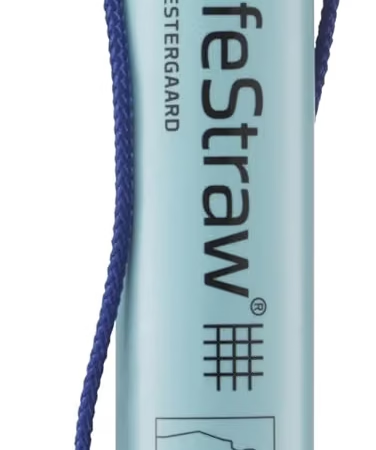
The LifeStraw Personal Water Filter is designed around a simple idea: provide a lightweight filtration device that allows an individual to drink directly from a natural water source. The blue version is a compact straw-style filter intended for activities such as hiking, camping, travel, and emergency preparedness.
The current LifeStraw specifications describe a 0.2-micron membrane microfilter designed to remove 99.999999% of bacteria, 99.999% of parasites, and 99.999% of microplastics, dirt, sand, and cloudiness under the manufacturer’s stated testing conditions. LifeStraw also states that the filter is independently tested and meets US EPA and NSF P231 standards for the removal of bacteria and parasites.
At the same time, understanding what a personal water filter does not remove is just as important as understanding what it does. The standard LifeStraw Personal Water Filter is a membrane microfilter, not a purifier designed to remove viruses. LifeStraw’s own product comparison distinguishes the Personal Water Filter from its ultrafiltration products that provide virus protection.
That distinction matters when choosing a water-treatment method for a particular environment.
This guide explains the LifeStraw Personal Water Filter’s design, filtration technology, practical uses, limitations, maintenance requirements, and differences between a personal straw filter and other portable water-treatment options.
What Is the LifeStraw Personal Water Filter?
The LifeStraw Personal Water Filter is a compact, straw-shaped drinking filter designed for individual use.
Instead of collecting water in a large container and filtering an entire batch, the user can place the intake end in an appropriate water source and draw water through the filter.
This direct-drinking design keeps the product simple and lightweight.
LifeStraw lists the current Personal Water Filter at approximately 1.6 ounces, or 46 grams, with dimensions of about 9 × 1.2 inches, or 22.9 × 2.5 centimeters. The package includes the LifeStraw, a lanyard, and a user manual. The product is made with BPA-free materials.
The filter uses a membrane microfilter with pores measuring approximately 0.2 micron.
According to LifeStraw, this filter is designed to remove bacteria, parasites, microplastics, dirt, sand, and cloudiness. The manufacturer lists examples of parasites such as Giardia and Cryptosporidium among the organisms addressed by the filter.
The result is a compact piece of equipment intended to make certain untreated freshwater sources more practical to use.
However, the quality and type of the water source still matter. A filter designed for biological contaminants is not automatically appropriate for every kind of contaminated water.
Key Features
0.2-Micron Membrane Microfilter
The central component is the membrane microfilter.
The manufacturer specifies a pore size of 0.2 micron.
The basic principle is mechanical filtration: water is drawn through microscopic pores while larger particles and microorganisms are retained by the membrane.
According to LifeStraw, the Personal Water Filter removes:
- 99.999999% of bacteria
- 99.999% of parasites
- 99.999% of microplastics
- Dirt
- Sand
- Cloudiness
These figures refer to the manufacturer’s stated performance under its testing conditions and should not be interpreted as a guarantee that every possible contaminant will be removed from every water source.
Understanding that distinction is especially important when the water source may contain chemical contamination.
Protection Against Common Waterborne Bacteria
Bacteria can be a significant concern when drinking untreated water.
LifeStraw states that its Personal Water Filter is designed to remove 99.999999% of bacteria and that the product meets US EPA and NSF P231 drinking-water standards for the removal of bacteria and parasites.
This is one reason the product is intended for outdoor and emergency applications.
Natural water can look clean while still containing microorganisms that cannot be detected by sight or taste.
Filtration therefore provides a treatment step that visual inspection alone cannot provide.
Parasite Filtration
The filter is also designed to remove 99.999% of parasites, including Giardia and Cryptosporidium.
These organisms are relevant to outdoor water safety because natural freshwater can be exposed to animal waste and other sources of biological contamination.
A clear mountain stream is not automatically safe to drink simply because the water looks clean.
The filtration system is intended to address certain biological contaminants that may otherwise be invisible.
Microplastic Filtration
LifeStraw also states that the membrane removes 99.999% of microplastics, along with dirt, sand, and cloudiness.
This adds another function beyond microbial filtration.
The filter can therefore help reduce visible suspended material as well as microscopic plastic particles covered by the manufacturer’s specifications.
Lightweight Construction
At approximately 1.6 ounces, or 46 grams, the Personal Water Filter is designed for portability.
Weight becomes increasingly important when hiking or backpacking.
Carrying several liters of drinking water can quickly add significant weight to a backpack. A compact filtration device does not eliminate the need to carry water, but it can reduce the amount that needs to be carried when reliable water sources are available along the route.
For emergency preparedness, low weight is also useful because the filter can be kept in a compact kit without adding much bulk.
Long Filter Life
LifeStraw currently specifies a maximum filtration capacity of up to 1,000 gallons, or approximately 4,000 liters, for the Personal Water Filter.
The actual lifespan can depend on water quality and usage conditions.
Water containing significant amounts of sediment can place more demand on the membrane than relatively clear water.
LifeStraw explains that membrane microfilter flow will slow or stop when the filter reaches the end of its life.
That behavior provides an important practical indicator.
A substantial reduction or complete stop in water flow can indicate that the filter has reached the end of its useful life.
Long Shelf Life When Stored Properly
LifeStraw states that the Personal Water Filter has unlimited shelf life when stored properly and unused.
This characteristic can be particularly useful for emergency preparedness.
An emergency kit may remain untouched for months or years.
A product with a long storage life is easier to include in a preparedness kit without worrying about replacing it according to a short calendar-based expiration date.
Proper storage is still important.
The manufacturer provides storage and cleaning instructions, and those instructions should be followed rather than assuming that any storage environment is suitable.
Simple Straw-Style Design
The Personal Water Filter does not require a complicated pump system.
Its design is based around drinking directly through the straw.
That simplicity can be useful in situations where minimizing equipment is important.
There are no batteries to charge and no electrical components required for basic filtration.
At the same time, the direct-drinking format creates limitations that are important to understand.
The user generally needs to position the filter directly at the water source or use an appropriate container to make the water accessible.
It is not designed to produce a large volume of filtered water for an entire group in the same way as a gravity or batch filtration system.
How the LifeStraw Filtration Process Works
The Personal Water Filter uses membrane microfiltration.
When the user draws water through the straw, water passes through the membrane.
The membrane’s small pores allow water to pass while retaining many larger particles and microorganisms.
The process does not rely on adding chemicals to the water.
It also does not require electricity.
This makes the filter particularly useful for situations where access to power is limited.
However, filtration is different from chemical treatment.
A membrane filter is primarily addressing physical and biological contaminants that fall within its filtration capabilities.
It does not automatically neutralize every substance that might be dissolved in water.
That distinction is essential when selecting a water-treatment method.
What the LifeStraw Personal Water Filter Removes
According to the manufacturer’s current specifications, the filter is designed to remove:
Bacteria
The manufacturer states a reduction of 99.999999% of bacteria under its stated testing conditions.
Parasites
The filter is designed to remove 99.999% of parasites, including Giardia and Cryptosporidium.
Microplastics
LifeStraw states that the membrane removes 99.999% of microplastics.
Dirt and Sand
The membrane also removes dirt and sand particles.
Cloudiness
Suspended particles responsible for cloudiness can also be reduced by the filtration process.
These capabilities make the filter useful for many natural freshwater situations.
But the list is equally important for understanding what is not included.
What the LifeStraw Personal Water Filter Does Not Remove
Viruses
The standard Personal Water Filter is not the same as a virus-removing purifier.
LifeStraw’s product comparison identifies the Personal Water Filter as a 0.2-micron membrane microfilter, while its ultrafiltration products use smaller 0.02-micron membranes for virus protection.
This is a critical distinction.
If viral contamination is a realistic concern in the intended environment, users should choose a water-treatment system specifically designed and tested for virus reduction or use an appropriate additional treatment method.
Dissolved Chemicals
A membrane microfilter should not be assumed to remove dissolved chemicals simply because it removes microorganisms.
Potential contaminants such as industrial chemicals, pesticides, fuels, or other dissolved substances require different treatment technologies.
For example, some LifeStraw products include activated carbon or other technologies for additional contaminant reduction, but the standard Personal Water Filter is not an activated-carbon system. LifeStraw’s comparison information specifically distinguishes products with carbon filtration from the Personal Water Filter.
Salt
The Personal Water Filter is not designed to turn seawater into freshwater.
Salt is dissolved at a molecular level and requires desalination technology such as reverse osmosis rather than a standard microfilter.
Therefore, ocean water and other highly saline water sources should not be treated as appropriate sources for this product.
Heavy Metals and Other Dissolved Contaminants
The standard membrane is not a universal solution for dissolved metals or other chemical contaminants.
If a water source is suspected to contain industrial pollution, mining contamination, agricultural chemicals, or other hazardous substances, a basic personal microfilter should not be relied upon as the sole treatment method.
How the LifeStraw Can Be Used for Hiking
Hiking is one of the most natural applications for a personal water filter.
A hiker can carry a smaller amount of water between reliable freshwater sources and use the filter when additional drinking water is needed.
This can reduce the weight associated with carrying an entire day’s water supply when the route provides appropriate sources.
However, route planning remains important.
A hiker should never assume that a water source shown on a map will contain accessible or safe water.
Seasonal streams can dry up.
Water sources can become inaccessible.
A source can also be contaminated by upstream activity.
A good hiking plan therefore considers both water availability and water quality.
The filter is a treatment tool, not a replacement for planning.
Camping Applications
Camping trips can provide several opportunities for a personal water filter.
A camper might use it at a lake, stream, or other suitable freshwater source.
Because the device is designed for direct drinking, it can be especially convenient when an individual needs water rather than when a whole group needs several liters at once.
For group camping, a larger gravity or batch filtration system may be more practical.
The LifeStraw can still serve as an individual backup.
This makes it useful as part of a layered approach to water preparedness.
Backpacking and Weight Management
Backpackers often need to balance water capacity with pack weight.
Water is heavy.
One liter of water weighs approximately one kilogram before accounting for the container.
If a route provides reliable water sources, a filtration device can reduce the amount that needs to be carried between those locations.
The LifeStraw’s approximately 46-gram weight makes it relatively easy to include as part of a lightweight kit.
However, water availability should always be confirmed before depending on filtration.
In a dry environment, carrying sufficient water remains essential even if a filter is available.
Travel Applications
A portable water filter can also be relevant during travel.
However, the appropriate use depends heavily on the destination.
In many urban environments, treated municipal tap water may already be appropriate for drinking.
In locations where tap water safety is uncertain, a traveler may want additional water-treatment options.
The LifeStraw Personal Water Filter is designed primarily around direct drinking from natural freshwater sources rather than as a comprehensive chemical treatment system for unknown urban water supplies.
Travelers should therefore investigate the water conditions at their destination rather than assuming that a personal filter solves every water-quality issue.
Emergency Preparedness
A compact water filter can be useful as part of an emergency kit.
During certain emergencies, access to municipal water can become temporarily disrupted or a household may need to obtain water from alternative sources.
The LifeStraw’s long storage life and lack of batteries make it convenient to keep in a preparedness kit. LifeStraw states that the unused product has unlimited shelf life when stored properly.
Still, emergency planning should not rely on one piece of equipment.
Stored drinking water remains important.
A filter is better understood as an additional capability that can extend options when an appropriate source is available.
Using the LifeStraw in a Natural Water Source
Selecting the water source is an important part of safe use.
Whenever possible, look for flowing water rather than stagnant pools.
Avoid areas where water appears contaminated by:
- Fuel
- Industrial discharge
- Chemicals
- Dead animals
- Heavy agricultural runoff
- Sewage
- Unusual odors
- Visible pollution
A filter designed to remove microorganisms cannot make chemically contaminated water safe simply by passing it through the membrane.
When collecting water in the outdoors, upstream conditions also matter.
A clear section of a river can still receive contamination from activity further upstream.
Why Clear Water Is Not Necessarily Safe Water
One of the most common misconceptions about natural water is that clear water is automatically safe.
Microorganisms are microscopic.
A stream can look clean while containing bacteria or parasites.
That is why visual inspection alone is not a reliable water-safety method.
The LifeStraw’s membrane filtration addresses certain biological contaminants precisely because they cannot be identified simply by looking at the water.
At the same time, visual clarity should not be confused with chemical safety.
Water can be clear and still contain dissolved substances that a microfilter does not remove.
Who the LifeStraw Personal Water Filter May Be Suitable For
Hikers
Hikers who regularly travel near reliable freshwater sources may find a compact personal filter useful for reducing the amount of water they need to carry between sources.
Backpackers
The low weight makes it relevant to people who carefully manage pack weight.
Campers
Campers can use it as an individual water-treatment option or as a backup alongside larger water systems.
Travelers
Travelers may appreciate the small size when packing outdoor or emergency equipment.
Its usefulness for a specific destination depends on local water conditions.
Emergency Preparedness Users
People assembling emergency kits can include a compact filter as one layer of their water plan.
Outdoor Enthusiasts
Fishing, hiking, hunting, bushcraft, and other outdoor activities may involve situations where access to natural freshwater is part of the trip.
Important Things to Consider
A Water Filter Is Not the Same as a Water Purifier
This is perhaps the most important distinction.
The LifeStraw Personal Water Filter uses a 0.2-micron membrane microfilter.
LifeStraw’s products that provide virus protection use ultrafiltration membranes with smaller pores.
Therefore, users should select the product category based on the actual water risks they expect to encounter.
Know the Water Source
A filter can only address contaminants within its intended performance range.
If the water source is contaminated with chemicals, fuels, pesticides, or other dissolved pollutants, a basic microfilter is not an appropriate universal solution.
Do Not Use It With Salt Water
Seawater requires desalination.
The Personal Water Filter is not a desalination device.
Consider Virus Risk
If viruses are a realistic concern, additional treatment may be required.
The standard Personal Water Filter should not be presented as a virus-removal system.
Flow Rate Can Change
LifeStraw’s current comparison information lists the Personal Water Filter at approximately 2.1 liters per minute, with a tolerance of ±30%.
Actual flow can vary with water quality and filter condition.
As sediment accumulates, flow can decrease.
Eventually, the filter can stop passing water when it reaches the end of its usable life.
Filter Life Depends on Conditions
The stated maximum capacity is up to 4,000 liters or 1,000 gallons.
That figure should not be interpreted as an exact guarantee for every user and every water source.
Water containing substantial sediment can affect performance.
Following the manufacturer’s cleaning, storage, and usage instructions is important.
Direct Drinking Is a Specific Design Choice
The straw format is convenient for individual use.
It is less convenient when a group needs a large amount of filtered water.
For group camping or household emergency use, a gravity or larger-capacity system may be more appropriate.
Carry Backup Water
Never assume that a filter eliminates the need to carry water.
If a route has uncertain water availability, carry enough water to safely complete the route or adjust the plan.
A filter is most useful when reliable sources exist.
Caring for the LifeStraw
Proper care helps preserve the filter’s performance.
LifeStraw provides product-specific cleaning and long-term storage instructions.
After using the filter, follow those instructions carefully.
The filter should also be stored appropriately when not in use.
Do not improvise cleaning procedures that could damage the membrane.
One of the important practical differences between this product and a disposable straw is that the Personal Water Filter is designed for repeated use until the membrane reaches its capacity.
LifeStraw states that the Personal Straw does not have a replaceable filter; it is considered a single-use filter product once its filtration life is exhausted.
That means users should pay attention to the filter’s condition and plan for replacement rather than expecting to install a new membrane cartridge into the same straw.
Knowing When the Filter Has Reached the End of Its Life
The manufacturer explains that membrane microfilter water flow will slow or stop once the filter reaches the end of its life.
This is useful because filtration capacity can be difficult to track manually.
A person might not know exactly how many liters have passed through the filter during a long series of trips.
A significant decrease in flow can therefore serve as an important practical indicator.
Do not attempt to force excessive pressure through a filter that has reached the end of its useful life.
Replace the product according to the manufacturer’s guidance.
LifeStraw Personal Filter vs Portable Water Bottle Filter
Portable filtration bottles integrate the filter directly into a drinking bottle.
This can be convenient because water is stored and filtered within the same system.
The LifeStraw Personal Water Filter takes a different approach.
It is a direct-drinking straw that does not function as a storage bottle.
| Feature | LifeStraw Personal Straw | Filtered Water Bottle |
|---|---|---|
| Main format | Drinking straw | Bottle with integrated filter |
| Water storage | No | Yes |
| Weight | Very low | Generally higher |
| Direct source drinking | Yes | Usually requires filling bottle |
| Group use | Limited | Individual |
| Packability | Very compact | More bulky |
| Water availability | Requires source at time of use | Can carry filtered water |
| Typical use | Hiking, emergency backup, outdoor use | Hiking, travel, daily hydration |
The choice depends on whether the user values minimum weight or wants a container and filter combined into one system.
LifeStraw Personal Filter vs Pump Filter
Pump filters use a mechanical pump to force water through a filtration system.
Their main advantage is the ability to process larger amounts of water into a bottle or container.
They can be useful for groups and situations where several liters are needed.
The trade-off is additional weight, moving parts, and a more involved setup.
The LifeStraw’s direct-drinking format is simpler but designed around individual use.
For a solo hiker who wants an ultralight backup, a straw format can make sense.
For a group preparing several liters at camp, a larger filtration system may be more practical.
LifeStraw Personal Filter vs Gravity System
Gravity filters use elevation and gravity to move water through a filter.
They can process multiple liters without requiring the user to continuously squeeze or pump.
This makes them useful at campsites and for groups.
The downside is greater size and weight.
The LifeStraw Personal Water Filter is far more compact but does not provide the same batch-filtration capability.
Again, the appropriate category depends on the use case rather than one design being universally suitable.
LifeStraw Personal Filter vs Chemical Water Treatment
Chemical treatments such as certain water-purification tablets use chemicals to inactivate microorganisms.
Their advantages can include very low weight and easy storage.
However, chemical treatments can affect taste and may require waiting periods depending on the product.
A membrane filter works through physical filtration rather than chemical disinfection.
Some outdoor users carry both approaches to create redundancy.
Any combination should be used according to the instructions of each treatment method.
Building a More Complete Water-Preparedness Kit
A personal filter is more useful when combined with other appropriate equipment.
A hiking kit might include:
- Adequate drinking water
- A reusable bottle or hydration reservoir
- Personal water filter
- Backup treatment method where appropriate
- Water-storage container
- Navigation equipment
- Weather-appropriate clothing
- First-aid supplies
- Communication equipment
For an emergency kit, stored drinking water should remain a major component.
The filter is an additional tool rather than a replacement for stored water.
The principle is simple: prepare for both the availability of water and the ability to treat it.
Frequently Asked Questions
What does the LifeStraw Personal Water Filter remove?
The current manufacturer specifications state that it removes 99.999999% of bacteria, 99.999% of parasites, and 99.999% of microplastics, as well as dirt, sand, and cloudiness.
Does the LifeStraw remove viruses?
The standard LifeStraw Personal Water Filter is not designed as a virus-removing purifier.
LifeStraw distinguishes its 0.2-micron Personal Water Filter from its 0.02-micron ultrafiltration products that provide virus protection.
Can it make river water safe to drink?
It is designed to reduce bacteria and parasites in suitable freshwater sources, along with certain particles and microplastics.
However, not every river is an appropriate source. Water contaminated with chemicals, fuels, pesticides, or other substances outside the filter’s capabilities should not be treated as safe simply because it passes through the filter.
Can I use it with lake water?
It can be used with appropriate freshwater sources such as lakes, rivers, and streams, provided the water does not present contamination risks outside the filter’s capabilities.
Choose the cleanest practical source and avoid visibly or chemically contaminated water.
Can I use it with seawater?
No.
The Personal Water Filter does not desalinate water.
Seawater requires a desalination process such as reverse osmosis.
How small are the filter pores?
The membrane microfilter has a pore size of approximately 0.2 micron.
How long does the LifeStraw filter last?
LifeStraw states that the Personal Water Filter can filter up to 1,000 gallons, or approximately 4,000 liters, under its stated conditions.
Actual service life can vary with water quality and usage.
Does the filter have a replaceable cartridge?
The current LifeStraw replacement guide identifies the Personal Straw as a single-use filter product without a replacement filter.
Once the filtration element reaches the end of its useful life, the product should be replaced according to the manufacturer’s guidance.
How do I know when the filter is finished?
LifeStraw explains that membrane microfilter flow will slow or stop when the filter reaches the end of its life.
A substantial reduction in flow is therefore an important indication that replacement is needed.
How much does it weigh?
The current manufacturer specification lists the Personal Water Filter at approximately 1.6 ounces, or 46 grams.
How large is it?
LifeStraw lists dimensions of approximately 9 × 1.2 inches, or 22.9 × 2.5 centimeters.
Is the LifeStraw BPA-free?
Yes. The manufacturer lists BPA-free materials for the Personal Water Filter.
Does it require batteries?
No.
The Personal Water Filter uses mechanical membrane filtration and does not require batteries or electrical power for normal operation.
Can it be used during emergencies?
Yes. LifeStraw specifically identifies the Personal Water Filter as suitable for emergency preparedness and states that the unused product has unlimited shelf life when properly stored.
An emergency plan should still include stored drinking water and other appropriate supplies.
Is it suitable for backpacking?
Its low weight and compact size make it suitable for backpacking and other weight-sensitive outdoor activities. LifeStraw lists hiking and emergency preparation among its intended uses.
The availability of suitable water sources remains an important planning factor.
Can several people use one LifeStraw?
The device is designed primarily for individual direct drinking.
It can be carried as a backup for one person, but it is not a high-volume group filtration system.
For multiple people, a gravity, pump, or larger-capacity filtration system may be more practical.
Does it improve water taste?
The standard Personal Water Filter is not equipped with an activated carbon filter.
Its primary function is membrane filtration rather than broad taste and odor treatment.
LifeStraw’s product comparison distinguishes carbon-equipped products from the Personal Water Filter.
Does it remove chemicals?
The standard Personal Water Filter should not be treated as a general chemical-removal system.
It is designed primarily for biological contaminants and suspended particles within its stated filtration capabilities.
Can it remove dirt and sand?
Yes. LifeStraw states that the filter removes dirt and sand as well as cloudiness.
Can it filter muddy water?
It can remove certain suspended particles, but very muddy or sediment-heavy water can place greater demand on the filter.
Whenever possible, choose a clearer source or allow sediment to settle before filtering.
Can I carry it in an emergency backpack?
Yes.
Its compact dimensions and approximately 46-gram weight make it practical for many emergency or outdoor kits.
Does it expire?
LifeStraw states that the unused Personal Water Filter has unlimited shelf life when stored properly.
That does not mean it can be stored in any condition. Follow the manufacturer’s long-term storage guidance.
Can I use it every day?
The product can be reused until its filtration capacity is reached.
Whether it makes sense for daily use depends on the user’s water source and requirements.
It is primarily positioned as an outdoor, travel, and emergency filtration tool.
Is a LifeStraw enough for an emergency water plan?
Not by itself.
A comprehensive plan should account for stored water, appropriate containers, water-treatment methods, and the types of contamination that may occur.
A personal filter is one useful component rather than a complete emergency water system.
Conclusion
The LifeStraw Personal Water Filter is designed around a straightforward concept: provide an individual with a lightweight way to filter suitable freshwater while hiking, camping, traveling, or preparing for emergencies.
Its 0.2-micron membrane microfilter is specified to remove 99.999999% of bacteria and 99.999% of parasites, along with 99.999% of microplastics, dirt, sand, and cloudiness under the manufacturer’s stated testing conditions. LifeStraw also states that the product meets US EPA and NSF P231 standards for the removal of bacteria and parasites.
The compact design is one of its practical characteristics. At approximately 46 grams and around 9 inches long, it can be carried in a hiking pack, emergency bag, or travel kit without adding substantial weight.
Its limitations are equally important.
The Personal Water Filter is a microfilter rather than a virus-removing purifier. LifeStraw’s own product comparison distinguishes it from ultrafiltration products that use a smaller membrane pore size and provide virus protection. It also should not be considered a solution for seawater, fuel contamination, pesticides, industrial chemicals, or other dissolved contaminants outside its stated capabilities.
For outdoor use, choosing an appropriate water source remains essential. Clear water is not necessarily microbiologically safe, while chemically contaminated water may remain unsafe even after filtration.
The filter’s stated capacity of up to 4,000 liters or 1,000 gallons can provide substantial use for an individual, although actual lifespan depends on water quality and operating conditions. LifeStraw notes that flow will slow or stop when the membrane reaches the end of its useful life.
For hikers and backpackers who regularly encounter suitable freshwater sources, the compact straw format can provide a practical way to reduce the amount of water that needs to be carried between sources. For emergency preparedness, its long shelf life and lack of dependence on batteries make it a useful addition to a broader water plan.
Ultimately, the most important factor is understanding the difference between filtration and complete water purification. The LifeStraw Personal Water Filter is designed for specific biological and particulate contaminants, not every possible water hazard.
Used within those limitations and maintained according to the manufacturer’s instructions, it can serve as a compact piece of outdoor and emergency equipment.